• I Let My Date Drive Me Home — And I Still Regret It

    I Let My Date Drive Me Home — And I Still Regret It

    My brother has always considered himself the family’s unofficial matchmaker, even though his success rate is embarrassingly low. After enduring one disastrous setup after another, I had learned to keep my expectations low. Still, he insisted for weeks that I meet a man he played sports with—a polite, well-spoken guy he claimed would be perfect for me. I agreed to go on just one date, mostly to stop the constant convincing.

    To my surprise, the man seemed charming at first. He brought flowers, asked thoughtful questions, and treated the restaurant staff with respect. For the first part of the evening, I wondered if my brother had finally gotten something right. The date went smoothly, and nothing seemed out of the ordinary. When he insisted on driving me home, he framed it as courtesy rather than pressure. He didn’t try anything inappropriate, didn’t linger, and left with a friendly goodnight.

    For once, I felt hopeful—a feeling that had become rare. But that optimism vanished the next morning when I woke up to a payment request on my phone. He had sent me a detailed invoice for “expenses,” including gas, parking, and even a fee for “vehicle wear.” I laughed in disbelief before sending him more than he requested along with a note politely stating that I did not wish to see him again. I later learned he had a history of billing women after dates, treating kindness like a service and courtesy like a financial transaction.

    Several women online shared similar stories, turning the situation into a viral discussion about dating expectations and emotional labor. The more I read, the clearer it became that his behavior wasn’t a quirky misunderstanding—it was a pattern. In the end, the experience taught me an important lesson: genuine respect doesn’t come with a price tag. A kind person doesn’t tally up basic decency or turn dating into an invoice. I kept my boundaries, retired my brother from matchmaking duties, and filed this bizarre chapter away as a story that still makes people laugh—and shake their heads.

  • What I Found Plugged Into My House and What It Taught Me

    What I Found Plugged Into My House and What It Taught Me

    Last week, I went out into my backyard hoping for a quiet moment—and immediately noticed something odd.

    An orange extension cord stretched across my lawn like a neon path, running straight from my neighbor’s garage into my outlet on the back wall of the house. I paused, unsure what to think. Maybe it was a temporary thing, I reasoned. Maybe they’d plugged it in and forgotten. But as I traced it more closely, it became clear the connection had been made intentionally—without even asking me. For a moment, I felt puzzled rather than annoyed—we’d always gotten along well.

    Later that day, I decided to approach the situation calmly. I mentioned to my neighbor, “Hey, I think you plugged into my outlet by mistake—just so you know, that runs through my meter.” He laughed it off, saying it was “just a little power,” as if that made it okay. I didn’t want to create tension, so I simply added a small lockable cover to the outlet—a simple, respectful boundary to prevent future mix-ups.

    The next morning, I found a folded note in my mailbox that made my chest tighten with worry.

    Inside, my neighbor had written a sincere apology. He admitted he hadn’t considered how it might affect me, felt embarrassed, and assured me he didn’t intend to cause any problems. He hoped we could move past it. His honesty melted away any irritation I’d felt. That afternoon, I walked over to thank him in person. What started as a brief check-in soon turned into a thoughtful conversation about assumptions, communication, and the little ways neighbors affect each other’s lives.

    By the end of it, we understood each other far better than before—and even laughed about the whole situation. What could have turned into resentment instead became trust. That simple orange extension cord reminded me that clear communication, honesty, and goodwill can transform awkward moments into opportunities. Sometimes, the smallest misunderstandings teach the biggest lessons about patience, respect, and peaceful living with those around us.

  • My 2 A.M. Grocery Run Took a Terrifying

    My 2 A.M. Grocery Run Took a Terrifying

    My 2 A.M. Grocery Run Took a Terrifying Turn — Until the Cashier Sprinted After Me for a Reason I Never Saw Coming

    It was one of those nights when insomnia won and the fridge was completely empty. At 2:17 a.m. I found myself pushing a cart through the fluorescent-lit aisles of the 24-hour supermarket, the only customer except for one man who kept lingering a little too long near whatever section I was in.

    The cashier, a tired-looking guy in his late twenties with kind eyes, scanned my handful of items quickly. I paid, grabbed my bag, and practically speed-walked out the automatic doors, eager to get home. As soon as I hit the sidewalk, I heard footsteps behind me, steady and unhurried. I didn’t turn around at first, but when the steps didn’t fade, I glanced back.

    It was the man from the store.

    “Hey, walking kind of fast, aren’t you?” he called out, half-smiling.

    My stomach dropped. I clutched my bag tighter and picked up the pace. The footsteps stayed right behind me. I was calculating how many blocks until my apartment when suddenly someone shouted.

    “MISS! STOP! PLEASE!”

    I whipped around, heart in my throat, and saw the cashier from the store sprinting toward us, face white, waving something in the air.

    For one horrible second I thought, Great, now there are two of them. But he skidded to a stop beside me, panting, and held out… my wallet.

    “You left this on the counter,” he gasped. “I didn’t want you walking without your ID and cards this late.”

    Relief flooded me so hard my knees almost buckled.

    Then the cashier turned to the man who’d been following me and his entire demeanor changed.

    “Sir, I asked you to stay inside until the police got here. Please don’t move.”

    The man blinked, genuinely confused. “I was just going the same way as her…”

    Two patrol cars pulled up less than a minute later. While one officer talked to the man, the cashier quietly explained everything to me.

    That customer had been coming in for weeks, always late at night, sometimes trailing female shoppers to their cars until staff stepped in. Tonight, when he saw the man fixate on me, the cashier had been trying to catch my eye the whole time I was checking out—trying to warn me without causing a scene. When I bolted out the door and the man immediately followed, the cashier panicked, snatched my forgotten wallet, and ran after us to make sure I wasn’t alone.

    He didn’t want to scare me further by yelling “That guy is dangerous!” in the store. He just wanted me safe.

    It turned out the man wasn’t malicious; he was unhoused and struggling with untreated mental illness. He truly didn’t understand why walking behind a nervous woman at 2 a.m. could feel threatening. The officers knew him, spoke to him gently, and connected him with an outreach team that could help.

    After everything settled, the cashier insisted on walking me the last two blocks home. He stayed several respectful steps behind, hands in his pockets, just a quiet presence so I wouldn’t be alone.

    When we reached my building, I tried to thank him and ended up crying a little from the leftover adrenaline. He just shrugged, embarrassed.

    “Night shift gets weird sometimes,” he said. “We look out for each other. That’s all.”

    I still think about that cashier whenever I’m out late. The world feels a little less cold knowing there are people like him working the graveyard shift, noticing things most of us never see, and running—literally running—to keep a stranger from harm, even if it means looking like the bad guy for thirty terrifying seconds.

    Some heroes don’t wear capes. Some just wear faded store vests and care more than they’ll ever admit.

  • The Ingenious Design Behind the Small Hole in Your Padlock—and Other Everyday Secrets

    The Ingenious Design Behind the Small Hole in Your Padlock—and Other Everyday Secrets

    The Ingenious Design Behind the Small Hole in Your Padlock—and Other Everyday Secrets

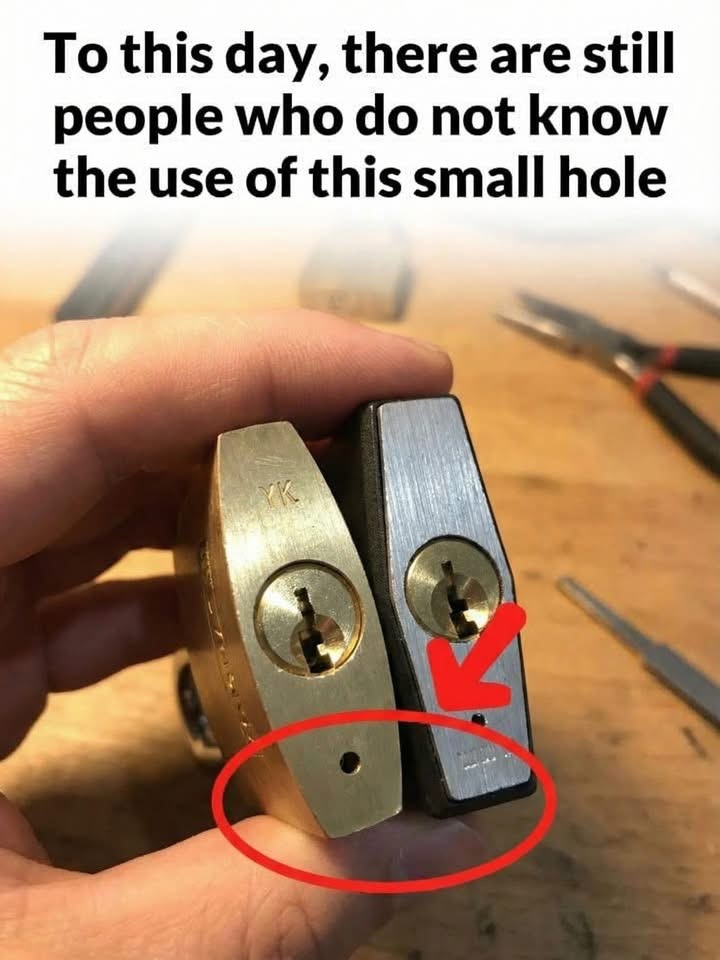
    Padlocks might seem like straightforward chunks of metal, but they’re packed with clever engineering to withstand the elements. That tiny hole at the bottom? It’s not a manufacturing flaw—it’s a lifesaver for your lock’s longevity. Let’s break it down, along with some other under-the-radar features in common items that make life smoother.

    Why That Hole Exists: Drainage and Maintenance in One

    Outdoor padlocks face constant threats from rain, dew, or even humid air, which can seep into the shackle and keyway. Without an escape route, this moisture turns into rust, gumming up the pins and springs inside. Over time, your reliable lock could seize up or fail entirely at the worst moment—like when you’re rushing to secure your bike.

    Enter the drainage hole: It’s strategically placed at the lowest point to let water gravity-drain out naturally, keeping the internals dry and corrosion-free. This simple vent has been a staple in traditional padlocks for decades, even as modern weather-sealed versions emerge. Bonus perk? It’s also a perfect entry for lock lubricant (like WD-40 or graphite powder). If your key sticks, just tip the lock upside down and squirt a bit in—problem solved without disassembly.

    Beyond Padlocks: Hidden Gems in Everyday Objects

    Designers love sneaking in these “aha” features to solve real problems quietly. Here are a few more that prove innovation thrives in the details:

    • Wrenches as Screwdriver Extenders: Ever struggled in a cramped space? Many adjustable wrenches have a round hole in the handle that doubles as a holder for a screwdriver shaft. Slide it in, and you’ve got an instant extender for better leverage and reach—ideal for automotive tweaks or furniture assembly.
    • Fabric Swatches in Quality Clothes: That extra scrap of material sewn into a seam isn’t just for color-matching detergent tests (though it works for that too). It’s a repair kit in miniature: Use it to patch snags, source exact-thread dye, or even test alterations without risking the whole garment.
    • Brass Fixtures for Hygiene: Brass isn’t chosen for doorknobs and handrails just for its shine—it’s naturally antimicrobial. Copper (brass’s key ingredient) kills bacteria on contact, reducing germ spread in high-touch areas like homes or hotels. A subtle health hack in plain sight.
    • Dashboard Fuel Arrows: On most cars, the gas pump icon on your fuel gauge has a tiny arrow pointing left or right. It indicates which side the tank filler is on—crucial for rentals, unfamiliar rides, or quick stops. No more awkwardly circling the lot!
    • Heinz’s Magic “57”: That iconic number on ketchup bottles? It’s not random—tap the bottle’s neck at the 57 mark (about two-thirds down) with your palm to dislodge stubborn sauce. Science-backed: It creates just the right vibration to break the flow without shaking wildly.

    These tweaks aren’t flashy, but they embody “form follows function”—solving annoyances with minimal fuss. Next time you fiddle with a lock or squeeze ketchup, pause to appreciate the thought. It might even inspire you to spot (and use) more of these in your daily routine. What overlooked feature have you discovered lately?

  • A research reveals your body knows when death is near, and it all starts in the

    A research reveals your body knows when death is near, and it all starts in the


    # The Human Body’s Mysteries: Can We Sense Death Approaching?

    Even with decades of scientific study and technological progress, there are still aspects of the human body that puzzle doctors and researchers. Given the incredible complexity of our biology, this should not come as a complete surprise.

    Some individuals are said to possess a “sixth sense,” allowing them to predict events before they happen. Interestingly, recent research suggests that humans may also have the ability to subconsciously detect when death is near.

    ## The Role of Putrescine in Death Detection

    When a person dies, the body begins to decompose almost immediately. In this process, a chemical compound known as putrescine—a toxic, foul-smelling substance—is released. Scientists have found that humans are capable of subconsciously recognizing this odor.

    More than just recognition, exposure to the scent triggers an instant reaction in the body. Researchers Arnaud Wisman from the University of Kent’s School of Psychology in the UK, and Ilan Shira from the Department of Behavioral Sciences at Arkansas Tech University in the U.S., explain that humans, like animals, use scent signals as survival mechanisms, often responding instinctively to danger.

    ## Human Reactions to the Smell of Decay

    Experiments conducted by Wisman and Shira revealed that people exposed to putrescine tend to instinctively distance themselves, mirroring animal behavior when faced with threats—choosing either to flee or prepare for confrontation.

    The researchers point out:

    “We do not know why we like or dislike certain smells, and we’re usually unaware of how odors influence our emotions, preferences, and attitudes.”

    Other scientists also note that while it may be difficult to think of a scent as frightening, odors can increase alertness and awareness of one’s surroundings.

    ## Scents and Human Behavior

    Scent has long been recognized as a powerful influencer of human behavior. For example, sex pheromones—chemicals released by both men and women—can trigger behavioral responses in the opposite sex, encouraging attraction and mating.

    By contrast, putrescine communicates an entirely different message. Researchers explain that while pheromones often promote attraction, the presence of putrescine tends to elicit avoidance or even aggression. What makes this more striking is that people are generally unaware of perceiving this smell or linking it directly to death or fear.

    ## Conclusion

    Although science has yet to fully explain the complexity of human senses, research indicates that our reactions to certain scents—particularly those tied to decay—play an important role in survival. Just as animals instinctively recognize danger through smell, humans may also unconsciously respond to chemical signals like putrescine, subtly shaping behavior in moments of threat.


  • The Morning a Simple Question Changed Everything

    The Morning a Simple Question Changed Everything

    My husband always showered before me. I’d hear the water running while I made coffee, and he’d call out silly things from behind the curtain. One morning, I heard him say, “Hey babe, come look at this mole on my back.


    Does it look bad?” I laughed and walked toward the bathroom. But then I saw…the curtain slightly open, the steam rolling out, and a tremble in his voice that I had never heard before. At first, I assumed he was just being dramatic—he had a habit of turning the smallest things into jokes for attention. But when I pulled the curtain back a few inches, expecting a playful grin, he wasn’t laughing. He was standing still, facing the tiled wall, his shoulders tense.

    The “mole” wasn’t really a mole at all—it was a dark patch that hadn’t been there before, uneven at the edges, almost shaped like a small splash of ink. For a second, my breath caught in my throat. “Hey,” I said softly, touching his arm, “let’s get it checked out. Just to be safe.” He nodded, but the fear in his eyes lingered.

    Over the next few days, we pretended life was normal—work, meals, evening walks—but there was a quiet heaviness between us. He tried to joke as usual, but the sparkle behind the jokes wasn’t quite the same. When the dermatologist appointment finally came, we sat in the waiting room holding hands, both of us pretending we weren’t imagining worst-case scenarios. The doctor examined the spot carefully, her expression calm, professional, unreadable. She told us she wanted to run a biopsy “just to be thorough,” and in that moment, the room seemed to shrink around us.

    On the drive home, he rested his head against the window and whispered, “I didn’t think something small could change everything.” I reached over and took his hand, wishing I could pull the worry right out of him.

    The waiting was the hardest part. Those days felt longer than entire seasons. We cooked together, watched old movies, even rearranged the living room just to feel like we had control over something. And somewhere in the quiet of those days, we talked more honestly than we had in years. He admitted he often hid his worries behind humor. I admitted I sometimes forgot that even the strongest people need reassurance. The fear we shared didn’t create distance—it somehow softened us, reminded us that every ordinary morning, every silly comment from behind a shower curtain, was its own kind of blessing.

    When the results finally came in, the doctor smiled and told us it was benign—nothing dangerous, nothing that required more than monitoring. My husband released a breath so deep it felt like it carried weeks’ worth of tension. That night, as we stood in the kitchen making tea, he wrapped his arms around me and said, “I’m never taking mornings for granted again.” And suddenly, the moment that had frightened us so deeply became a quiet reminder: life doesn’t always announce when it’s about to change, but sometimes those changes lead to gratitude we might never have discovered otherwise.

  • Nude Cruise Worker Secrets

    Nude Cruise Worker Secrets

    Worker on 2,000-Person Nude Cruise Shares What She Tells Passengers When They Get Aroused

    A woman who works aboard a massive 2,000-person nude cruise has opened up about one of the most common  and most sensitive  questions passengers ask: what to do if they become aroused in a public setting. According to her, it’s a concern many first-time nudists quietly worry about before stepping onto the ship.

    She explains that natural bodily reactions are nothing to be ashamed of, but there are strict guidelines to ensure everyone feels comfortable. If a passenger does get aroused, staff instruct them to simply wrap themselves in a towel, sit down, and give the moment time to pass. It’s a respectful, discreet way to handle a normal human reaction without drawing attention or making others uncomfortable.

    The worker adds that nudist environments emphasize body acceptance and non-sexual interaction, and most guests quickly adjust to the atmosphere. With clear rules, supportive staff, and a focus on relaxation rather than sexuality, the cruise aims to create a safe and respectful experience for all aboard.

  • I Picked Up My Dog from a 24/7 Daycare

    I Picked Up My Dog from a 24/7 Daycare

    There’s nothing quite like the warm welcome of a wagging tail after being away from your dog. For most pet owners, dogs are more than just animals—they’re beloved members of the family. That’s why entrusting them to a 24/7 daycare while you’re gone comes with the expectation that they will be safe, cared for, and happy in your absence.

    These pet daycare centers promise round-the-clock supervision, proper meals, and a secure environment where your dog can play and rest until your return. As a pet parent, you rely on these assurances to feel at ease during trips or long work hours, confident your furry friend is in good hands.

    However, imagine the shock after returning home from a two-week business trip. You’re tired, missing your dog, and ready to reconnect. She runs to greet you with excitement, her tail wagging and her eyes sparkling just as you remembered.

    Everything seems perfect—until a moment of joy turns to concern. While rubbing her belly, you suddenly notice something unusual. That unexpected discovery shatters your relief and raises questions about what happened during her stay at daycare.

    This unsettling moment reminds us that even in trusted environments, things can go unnoticed or unreported. It’s a wake-up call for pet parents to remain vigilant and ask questions. While these services are meant to offer peace of mind, it’s essential to regularly check on your dog’s well-being and advocate for her health, safety, and happiness at all times.

  • Naomi Whitehead: America’s Newest Voice

    Naomi Whitehead: America’s Newest Voice

    Naomi Whitehead officially became the oldest living person in the United States—a title that represents more than just age; it’s a bridge across generations.

    Born Naomi Washington on September 26, 1910, in rural Georgia, she grew up on a farm,

    helping pick cotton and tobacco while learning resilience, responsibility,

    and the value of hard work alongside her older siblings Douglas, Clarence, Ellen, and Viola. At 20, she married Sylvester Whitehead,

    and the couple raised three sons: Parrish, Elbert, and Sylvester Jr., growing a family that expanded through generations.

    On October 22, 2024, following the passing of Elizabeth Francis,

    Naomi Whitehead officially became the oldest living person in the United States—a title that represents more than just age; it’s a bridge across generations.

    Born Naomi Washington on September 26, 1910, in rural Georgia, she grew up on a farm, helping pick cotton and tobacco while learning resilience,

    responsibility, and the value of hard work alongside her older siblings Douglas, Clarence, Ellen, and Viola.

    At 20, she married Sylvester Whitehead, and the couple raised three sons: Parrish, Elbert, and Sylvester Jr., growing a family that expanded through generations.

  • I Raised My Late Girlfriend’s Daughter as My Own – Ten Years Later, She Says She Has to Go Back to Her Real Dad for a Heart-Wrenching Reason

    I Raised My Late Girlfriend’s Daughter as My Own – Ten Years Later, She Says She Has to Go Back to Her Real Dad for a Heart-Wrenching Reason

    Ten years after I adopted my late girlfriend’s daughter, she stopped me while I was preparing Thanksgiving dinner, shaking like she’d seen a ghost. Then she whispered the words that cracked the world under my feet: “Dad… I’m going to my real father. He promised me something.”

    Ten years ago, I made a promise to a dying woman, and, frankly, it’s the thing that’s mattered most in my life.

    Her name was Laura, and we fell for each other fast. She had a little girl, Grace, who had a shy laugh that melted me into a puddle.

    Grace’s bio dad had vanished the second he heard the word “pregnant.” No calls, no child support, not even a lame email asking for a photo.

    I stepped into the space he left vacant. I built Grace a slightly lopsided treehouse in the backyard, taught her to ride her bike, and even learned to braid her hair.

    She started calling me her “forever dad.”

    I’m a simple guy who owns a shoe repair shop, but having those two in my life felt like magic. I planned to propose to Laura.

    I had the ring ready.

    Then cancer stole Laura from us.

    Her last words still echo in the dusty corners of my little life: “Take care of my baby. You’re the father she deserves.”
    And I did.

    I adopted Grace and raised her alone.

    I never imagined that one day, her bio dad would turn our world upside down.

    It was Thanksgiving morning. It had been just the two of us for years, and the air was thick with the comforting smell of roasting turkey and cinnamon when I heard Grace enter the kitchen.

    “Could you mash the potatoes, sweetie?” I asked.

    Silence. I put down the spoon and turned.

    What I saw stopped me cold.

    She was standing in the doorway, shaking like a leaf, and her eyes were red-rimmed.

    “Dad…” she murmured. “I… I need to tell you something. I won’t be here for Thanksgiving dinner.”

    My stomach dropped.

    “What do you mean?” I asked.

    Then she said the sentence that felt like a fist to the chest.

    “Dad, I’m going to my real father. You can’t even imagine WHO he is. You know him. He promised me something.”

    The air rushed out of my lungs, leaving me hollow. “Your… what?”

    She swallowed hard, her eyes darting around the room as if looking for an escape route. “He found me. Two weeks ago. On Instagram.”

    And then she said his name.

    Chase, the local baseball star who was a hero on the field and a menace everywhere else, was her father. I’d read the articles; he was all ego and zero substance.

    And I loathed him.

    “Grace, that man hasn’t spoken to you in your entire life. He’s never asked about you.”

    She looked down at her hands, twisting her fingers tgether. “I know. But he — he said something. Something important.”

    Her voice cracked, a tiny, pained sound. “He said… he could ruin you, Dad.”

    My blood ran cold. “He WHAT?”

    She took a shaking breath, and the words tumbled out in a terrified rush. “He said he has connections and that he can shut down your shoe shop with one phone call. But he promised he wouldn’t if I did something for him.”

    I kneeled before her. “What did he ask you to do, Grace?”

    “He said if I don’t go with him tonight for his team’s big Thanksgiving dinner, he’ll make sure you lose everything. He needs me to SHOW everyone that he is a self-sacrificing family man who raised his daughter alone. He wants to steal YOUR role.”

    The irony, the sheer, disgusting nerve of it, made me feel sick. I felt something inside me just collapse.

    One thing was certain: there was no way I was going to lose my little girl!

    “And you believed him?” I asked gently.

    She burst into tears. “Dad, you worked your whole life for that shop! I didn’t know what else to do.”

    I took her hands in mine. “Grace, listen to me. No job is worth losing you. The shop is a place, but you’re my whole world.”

    Then she whispered something that made me realize the threats were just the tip of the iceberg.

    “He also promised me things. College. A car. Connections. He said he’d make me part of his brand. He said people would love us.” She hung her head. “I already agreed to go to the team dinner tonight. I thought I had to protect you.”

    My heart didn’t just hurt; it shattered into a thousand jagged pieces.

    I lifted her chin. “Sweetheart… wait. No one is taking you anywhere. Leave it to me. I have a plan for dealing with this bully.”

    The next few hours were a frantic rush as I put my plan into place.

    When everything was ready, I slumped at the kitchen table. What I had in mind would either save my family or leave it in ruins.

    The sound of someone banging their fist against the front door echoed through the house.

    Grace froze solid. “Dad… that’s him.”

    I walked to the door and opened it.

    There he was: Chase, the biological father. Everything about him was a performance: designer leather jacket, perfect hair, and, I kid you not, sunglasses at night.

    “Move,” he commanded, stepping toward me like he owned the place.

    I didn’t budge. “You’re not coming inside.”

    He smirked. “Oh, still playing daddy, huh? That’s cute.”

    Grace whimpered behind my back.

    He spotted her, and his smile widened into a predatory grin.

    “You. Let’s go.” He pointed at Grace. “We have photographers waiting. Interviews. I’m due for a comeback, and you’re my redemption arc.”

    And that’s when things started to get ugly.

    “She’s not your marketing tool,” I snapped. “She’s a child.”

    “My child.” He leaned in close, his cologne suffocating me. “And if you get in my way again, I’ll burn your shop to the ground — legally. I know people. You’ll be out of business by Monday, shoemaker.”

    I clenched my jaw. The threat felt very real, but I wouldn’t let him take my daughter. It was time to put my plan into action.

    I turned my head slightly to speak over my shoulder. “Grace, honey, go get my phone and the black folder on my desk.”

    She blinked, confused and teary. “What? Why?”

    “Trust me.”

    She hesitated for only a second, then ran toward my little workshop.

    Chase laughed. “Calling the cops? Adorable. You think the world will take YOUR side over MINE? I’m Chase, pal. I AM the world.”

    I smiled then. “Oh, I don’t plan to call the cops.”

    Grace came running back, clutching my phone and the folder.

    I opened it and showed Chase the contents: printed screenshots of every last threatening, coercive message he’d sent Grace about needing her for publicity and how she was the perfect “prop.”

    His face went white as paper.

    But I wasn’t done yet!

    I snapped the folder shut. “I already sent copies to your team manager, the league’s ethics department, three major journalists, and your biggest sponsors.”

    He lost control then.

    He lunged at me, his hand coming up.

    “Daddy!” Grace screamed.

    But I shoved him backward, sending him stumbling onto the lawn. “Get. Off. My. Property.”

    “You RUINED me!” he screamed, his voice breaking with disbelief. “My career, my reputation — my life!”

    “No,” I replied, looking him dead in the eye. “You ruined YOURSELF the second you tried to steal MY daughter.”

    He pointed a shaking finger at Grace. “You’ll regret this!”

    “No,” I said, stepping onto the porch to block her from his view entirely. “But you will.”

    He turned, stormed to his black, shiny car, and peeled out of the driveway, the sound of the tires squealing an appropriate end to his dramatic exit.

    The moment the sound faded, Grace collapsed. She fell into my arms, clinging to me as sobs shook her body.

    “Dad… I’m so sorry…” she choked out between gasps.

    The next few weeks were hell — for him, not us.

    Two major exposés were published, and within two months, Chase’s reputation and his career were in shambles.

    Grace was also a little quiet for a while, but one cold night, about a month after the dust had settled, I was teaching her how to repair a pair of sneakers when she said something that just about broke me.

    “Dad?” she whispered.

    “Yeah, sweetheart?”

    “Thank you for fighting for me.”

    I swallowed hard, the emotion catching in my throat. “I always will. You’re my girl, and I promised your mom I’d take care of you, always.”

    She frowned at me. “Can I ask something?”

    “Anything.”

    “When I get married one day,” she said, “will you walk me down the aisle?”

    Tears stung my eyes, the first ones since Laura died. It wasn’t a question about a wedding; it was a question about belonging, about permanence, about love.

    It was the only validation I ever needed.

    “There’s nothing I’d rather do, my love,” I whispered, my voice rough.

    She leaned her head on my shoulder. “Dad… you’re my real father. Always have been.”

    And for the first time since that terrible Thanksgiving morning, my heart finally, completely stopped hurting.

    The promise was kept, and the reward was a simple, profound truth: family is who you love, who you fight for, not just biology.

    If you could give one piece of advice to anyone in this story, what would it be? Let’s talk about it in the Facebook comments.

    If this story touched you, read this one next: My daughter spent weeks crocheting hats for sick children, but the day my husband left on a business trip, we came home to find her hard work gone… and my MIL standing in the doorway, admitting that she threw everything away. She thought she’d won, but she didn’t count on what my husband did next!